India is a land where science and spirituality do not contradict each other; instead, they dance in a sublime, eternal embrace. Deep within the heart of Telangana lies a living testament to this divine synergy—the Chhaya Someswara Temple. Located in Panagal, Nalgonda district, this 1,400-year-old shrine dedicated to Lord Shiva holds a secret that has baffled physicists, architects, and spiritual seekers for generations.
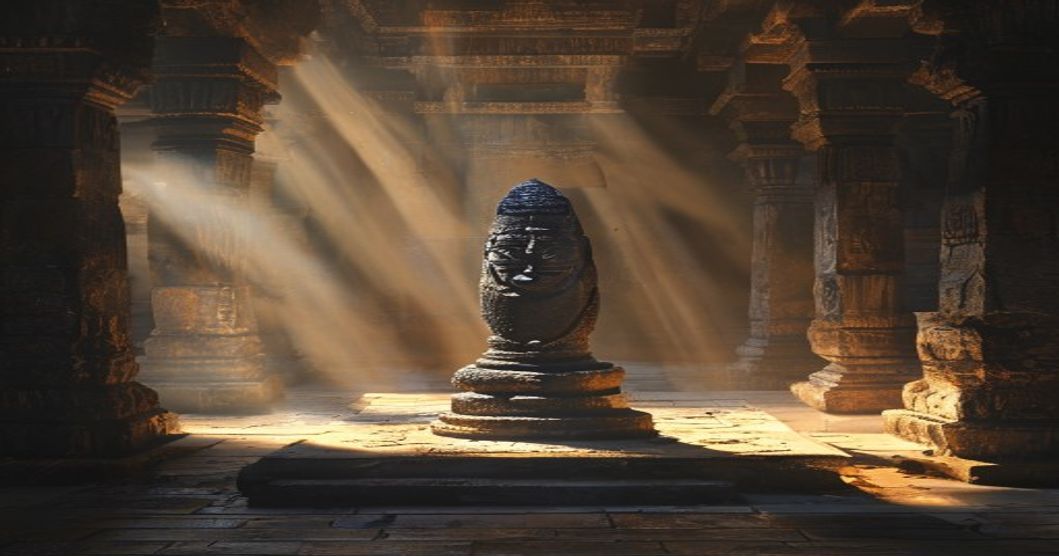
At the center of the temple’s inner sanctum (Garbhagriha) stands a magnificent Shiva Lingam. But what draws thousands of devotees and researchers is not just its ancient energy, but an inexplicable phenomenon: a dark, distinct shadow (Chhaya) that remains permanently cast upon the Lingam from sunrise to sunset. This shadow never moves, never fades, and defies the natural movement of the sun.
The Celestial Mystery of the Unmoving Shadow
According to local legends and spiritual experts, the shadow cast upon the deity is not a mere trick of light, but a celestial phenomenon. Traditional believers associate this shadow with the shadow planets Rahu and Ketu, as well as the mystical alignment of the Sun and Moon. In Vedic astrology, Rahu and Ketu are cosmic forces of shadow, and their eternal presence on the Shiva Lingam is believed to neutralize negative planetary influences for visiting devotees.
If you wish to explore more about such sacred mysteries, Vedic rituals, and spiritual wisdom, visit Hindu Dev Gyan, your ultimate guide to the eternal path of Sanatan Dharma.
What confounds modern science is that the shadow resembles that of a pillar. However, there is no pillar directly in front of the Shiva Lingam that could cast such a shadow. If you stand in front of the deity, your own shadow will not block this mysterious dark silhouette. It remains constant, untouched by human interference or the shifting angles of daylight.
Mythological Significance: The Alignment of Rahu, Ketu, and Shiva
In Hindu cosmology, Lord Shiva is known as Someswara (the Lord of the Moon, Soma). The name “Chhaya Someswara” translates to “The Lord of the Moon who holds the Shadow.” Vedic scholars believe that the temple was strategically consecrated to create a spiritual portal where the energies of the luminaries (Sun and Moon) and the shadow nodes (Rahu and Ketu) converge at the feet of Mahadev.
Devotees believe that meditating in the presence of this eternal shadow can help alleviate the malefic effects of:
- Kala Sarpa Dosha (planetary imbalance caused by Rahu and Ketu)
- Chandra Dosha (weak position of the Moon in one’s birth chart)
- Mental anxiety and spiritual blockages
The Genius of Ancient Hindu Architecture: Physics or Miracle?
While the spiritual vibration of the temple is undeniable, the physical manifestation of the shadow is a crowning achievement of ancient Hindu engineering. Built during the reign of the Kunduru Cholas (and later patronized by the Kakatiya dynasty), the temple is a masterclass in physics and optics.
Scientists who studied the temple discovered that the shadow is actually an optical illusion created by the scattering and diffraction of light. The architects designed the temple pillars in such a precise alignment that light entering from the east and west reflects off the multiple pillars, converging at a single point inside the dark sanctum to create a dark silhouette resembling a pillar shadow. This is a marvelous, real-world application of the pinhole camera effect, engineered centuries before modern physics documented it.
Key Features of Chhaya Someswara Temple
- The Trinity of Shrines: The temple is a Trikutalaya (three-shrine complex) dedicated to Lord Shiva, Vishnu, and Surya, showcasing the harmony of different Hindu traditions.
- Sculptural Marvels: The pillars are intricately carved with episodes from the Ramayana and Mahabharata, exhibiting the peak of Kakatiya art.
- Mystical Vibe: The sanctum remains cool even in the scorching heat of Telangana, holding a profound, meditative silence.
How to Experience the Divine Grace
The Chhaya Someswara Temple is easily accessible from Hyderabad, located just about 100 km away. The best time to visit is during Maha Shivaratri or during Kartik Purnima, when the spiritual energy of the temple is at its zenith. Standing before the Chhaya Someswara Lingam, one realizes that the ancient Rishis and architects did not just build temples; they created cosmic instruments designed to connect the human soul with the infinite divine.