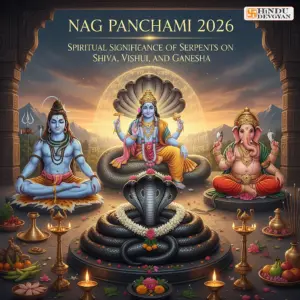
Among the countless deities in the Hindu pantheon, Lord Shiva (Mahadev) is perhaps the most intriguing. Adorned not with gold and silken robes, but with holy ash (Bhasma), a tiger skin, a crescent moon, and a deadly snake coiled around His neck, Shiva’s form is a masterclass in cosmic symbolism.
For centuries, devotees and spiritual seekers have asked: Why does Lord Shiva wear a venomous snake around His neck? This is not a mere aesthetic choice; it is a profound representation of Vedic philosophy, ancient mythology, and deep spiritual truths. Let us unravel the divine mystery of King Vasuki and the Lord of Destruction.
The Legend of Samudra Manthan and King Vasuki
According to the Puranas, the primary serpent resting around Lord Shiva’s neck is Vasuki, the king of serpents. The most famous legend associated with Vasuki is the Samudra Manthan (the churning of the cosmic ocean) conducted by the Devas (gods) and Asuras (demons) to obtain Amrit, the elixir of immortality.
Mount Mandara was used as the churning rod, and King Vasuki graciously offered himself as the churning rope. During this intense process, a lethal poison called Halahala emerged from the ocean, threatening to incinerate the entire universe. To save creation, Lord Shiva drank the poison, holding it in His throat, which turned blue, earning Him the name Neelkanth.
However, the intense heat of the poison was unbearable. It is said that Vasuki, who had also inhaled toxic fumes during the churning, was blessed by Shiva. To cool the serpent and honor his selflessness, Mahadev wore Vasuki as an ornament around His neck. The cold nature of the snake helped soothe the burning sensation of the Halahala poison, signifying a bond of eternal protection and devotion.
The Spiritual Symbolism of the Three Coils
In Vedic iconography, nothing is accidental. The serpent Vasuki is wrapped exactly three times around Mahadev’s neck. Scholars of ancient scriptures explain that these three coils represent the ultimate mastery over time and nature:
- The Three Tenses of Time: The coils represent the Past, Present, and Future. By wearing them around His neck, Shiva demonstrates that He is Mahakaal—the Lord of Time, who exists beyond its temporal constraints.
- The Three Gunas: They represent Sattva (purity), Rajas (passion), and Tamas (darkness/inertia). Shiva controls these three primordial forces of creation.
- The Ego and Fear: Snakes symbolize death, fear, and venomous ego. By wearing a serpent calmly as a necklace, Shiva teaches us that an enlightened mind can subdue the deadliest of fears and poisons.
Astrological Relevance: Overcoming Kaal Sarp Dosha
In Vedic astrology, serpents hold immense power. The shadow planets Rahu and Ketu are represented as the head and tail of a cosmic snake. When all planets are hemmed between Rahu and Ketu in a native’s birth chart, it forms the dreaded Kaal Sarp Dosha.
Because Lord Shiva is the absolute master of serpents, worshipping Him is considered the ultimate remedy for snake-related afflictions in one’s horoscope. Praying to Mahadev, especially on Maha Shivratri or Naag Panchami, pacifies the negative influences of Rahu and Ketu, bringing peace and stability to the devotee’s life.
Lessons for the Spiritual Seeker
The image of Shiva and the serpent offers practical wisdom for our spiritual journey. It reminds us that poisons—whether in the form of negative thoughts, toxic environments, or the inevitable challenges of life—can be transmuted into ornaments of wisdom when approached with a calm, meditative mind.
By conquering our inner vices and aligning our daily actions with the universal laws of Karma, we too can rise above the worldly illusions of fear and desire.
Are you eager to dive deeper into the mystical realms of Hindu mythology, Vedic astrology, and daily spiritual practices? Explore more authentic scripts and wisdom at HinduDevGyan to enrich your spiritual path.