
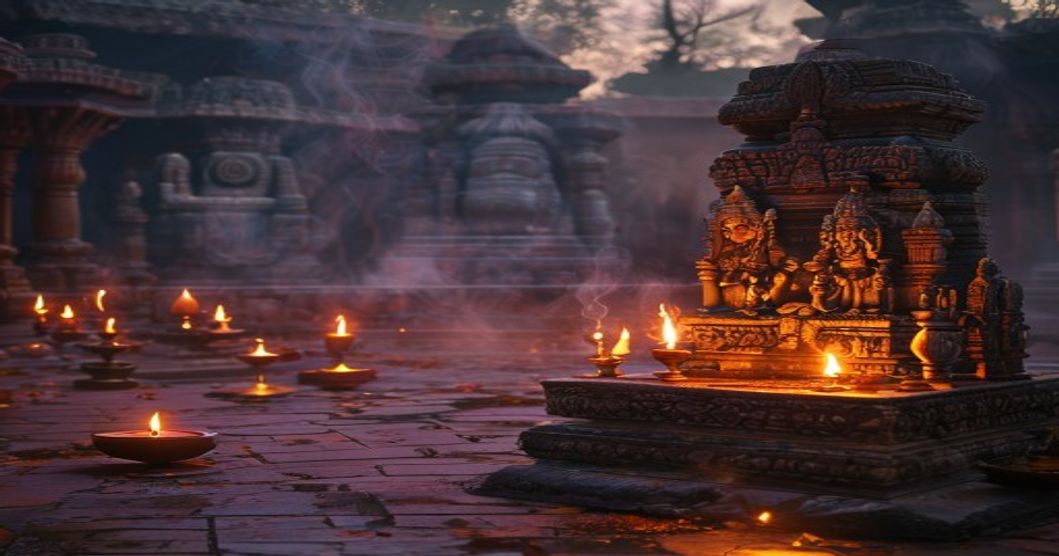
Stepping into an ancient Hindu temple is like entering a living museum of cosmic energy, sacred geometry, and profound theology. If you have visited both Shaivite (dedicated to Lord Shiva) and Vaishnavite (dedicated to Lord Vishnu) temples, you might have noticed a striking structural difference. In almost every traditional Shiva temple, there is a dedicated shrine for the Navagrahas (the nine planetary deities) located in the northeastern corner. However, in Vaishnava temples, this planetary enclosure is conspicuously absent.
This is not a random architectural choice. It is a deep-seated theological mystery rooted in the Vedas, Puranas, and the fundamental differences between Shaiva and Vaishnava philosophies. To deepen your understanding of ancient Hindu traditions, rituals, and temple architecture, explore the profound wisdom curated at Hindu Dev Gyan.
Lord Shiva as Mahakala: The Master of Time and Destiny
To understand why the Navagrahas reside within Shiva temples, we must look at the cosmic role of Lord Shiva. In Vedic scriptures, Shiva is revered as Mahakala (the Lord of Time) and Graheshwara (the Lord of the Planets). The nine planets—Surya (Sun), Chandra (Moon), Mangala (Mars), Budha (Mercury), Brihaspati (Jupiter), Shukra (Venus), Shani (Saturn), Rahu, and Ketu—are responsible for dispensing karma. They govern the time, lifespan, and destiny of all living beings.
Since the planets operate under the supreme command of Lord Shiva, they are considered part of his celestial court. In fact, planetary deities like Shani Dev (Saturn) and Surya Dev (the Sun) are ardent devotees of Shiva. Worshipping the Navagrahas in a Shiva temple signifies that by surrendering to the Supreme Lord of Time, one can pacify the malefic influences of the planets. Shiva has the ultimate power to alter destiny and mitigate the severity of one’s planetary defects (Graha Doshas).
The Vaishnava Path: Absolute Surrender and Sharanagati
In contrast, Vaishnavism centers around the concept of Sharanagati—absolute, unadulterated surrender to the Supreme Preserver, Lord Vishnu (or His incarnations, Lord Krishna and Lord Rama). According to Vaishnava theology, Lord Vishnu is the source of the entire cosmos, including the material laws governed by the planets.
Vaishnavism teaches that once a devotee surrenders completely to Lord Vishnu, they transcend the laws of material karma. The planetary deities, who are administrative demigods (Devas) executing cosmic laws, do not interfere with a pure devotee of Vishnu. Since Vishnu’s grace is absolute, a Vaishnava does not need to worship the planetary deities separately. Seeking blessings from the master renders pleas to the servants redundant.
Scriptural Contrasts: Shaivism vs. Vaishnavism
The absence and presence of the Navagrahas highlight the beautiful diversity of Hindu spiritual paths. Here are the core scriptural and philosophical differences between the two traditions regarding planetary worship:
- The Role of Karma: In Shaivism, Lord Shiva allows the Navagrahas to deliver the fruits of karma to devotees, but He provides the strength and grace to endure or overcome them. In Vaishnavism, Lord Vishnu is believed to directly dissolve the negative karma of a surrendered soul, bypassing planetary intervention entirely.
- The Divine Court: In a Shiva temple, the Navagrahas are placed in a specific grid, facing different directions to balance cosmic energies. In a Vishnu temple, the surrounding deities are usually Vishnu’s eternal companions, such as Garuda, Hanuman, Vishvaksena, and the Ashta Dikpalas (guardians of the directions), rather than the planetary lords.
- Cosmic Administration: Vaishnava texts like the Srimad Bhagavatam state that the Sun and other planets are simply physical manifestations of the Lord’s universal form (Virat Rupa). Therefore, worshipping Vishnu is equivalent to watering the roots of a tree, which automatically nourishes all the branches (the planets).
The Harmonious Vedic Vision
Ultimately, neither path is superior; they represent two different approaches to the same cosmic truth. Shaivism acknowledges the cosmic hierarchy and provides a structured way to harmonize with the celestial forces through the Navagrahas under Shiva’s watchful eyes. Vaishnavism offers a path of direct, singular devotion, assuring believers that the divine shield of Lord Vishnu protects them from all astrological turbulence.
The next time you visit these sacred spaces, look beyond the stone structures. The presence or absence of the Navagrahas is a profound reminder of how our ancient sages integrated complex cosmology, astronomy, and deep spiritual philosophy into the very walls of our temples.