
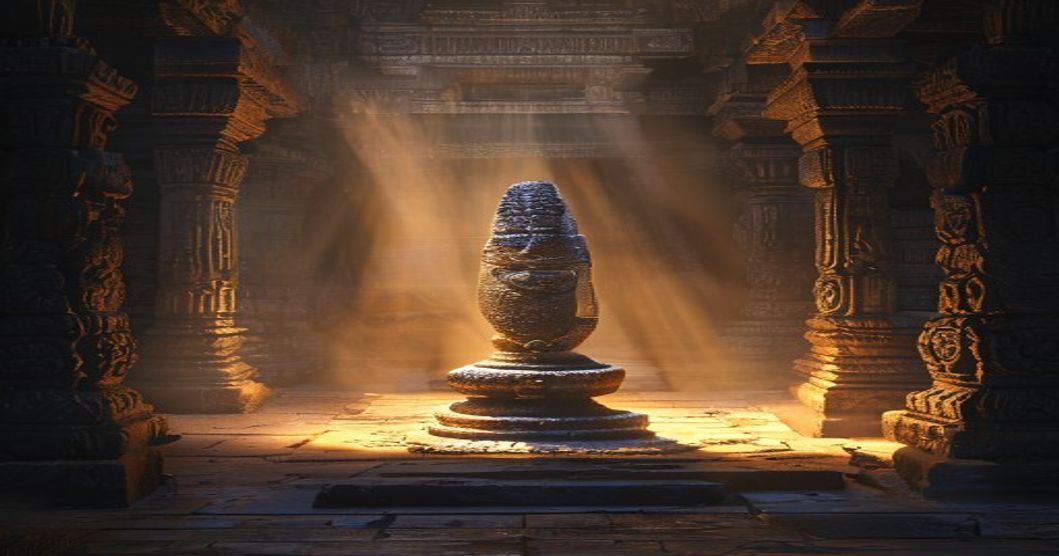
India is a land where the boundaries between science, architectural brilliance, and divine mysticism blur into a seamless reality. Among the countless spiritual wonders dotting the landscape of Bharat, the Chhaya Someswara Temple stands as a towering testament to ancient Vedic wisdom and structural engineering. Located in Panagal, Nalgonda district of Telangana, this 1,400-year-old shrine dedicated to Lord Shiva harbors a celestial secret that has baffled scientists, physicists, and spiritual seekers for generations.
At the heart of this ancient temple lies a profound mystery: a perpetual, dark shadow (Chhaya) hovers over the sacred Shiva Lingam from sunrise to sunset. What makes this phenomenon truly miraculous is that there is no physical pillar or obstacle directly in front of the deity that could cast such a shadow. For centuries, devotees have believed this shadow to be the mystical presence of cosmic forces—specifically the shadow planets Rahu and Ketu, along with the divine energies of the Sun and Moon—constantly paying obeisance to Mahadev.
For those who seek to explore the profound depths of Sanatana Dharma and understand the esoteric secrets of our heritage, visiting the sacred repositories of knowledge at Hindu Dev Gyan reveals how our ancestors seamlessly blended advanced material sciences with sublime spiritual truths.
The Mystical Phenomenon of the Eternal Shadow
The term “Chhaya” literally translates to shadow, and “Someswara” refers to the Lord of the Moon (Shiva). True to its name, the temple’s main sanctum (Garbhagriha) features an unchanging, vertical shadow that drapes perfectly over the Shiva Lingam. No matter how the sun moves across the sky, from dawn to dusk, this shadow remains absolutely stationary, steady, and unbroken.
In Hindu astrology, shadow plays a highly significant role. Rahu and Ketu are designated as Chhaya Grahas (shadow planets) that influence human destiny and cosmic events. Devotees and Vedic scholars believe that the shadow on the Lingam represents these cosmic shadow entities bowing down to the supreme consciousness of Lord Shiva, who is the master of all celestial bodies and time itself (Mahakal).
Architectural Genius: The Vedic Science of Light and Reflection
While the spiritual experience of the temple is deeply moving, the scientific principles behind its construction are equally mind-boggling. Built during the reign of the Kunduru Cholas (around the 11th and 12th centuries, with roots going back even further to the Chalukyan era), the temple is a masterclass in physics and optics.
The architects utilized a complex system of light reflection and scattering. The temple is designed in the Trikutachala (three-shrine) style, featuring three sanctums facing different directions. The pillars of the temple are positioned in such precise alignment that they catch the light entering from the entrance hall and reflect it multiple times.
The shadow cast upon the Shiva Lingam is not actually the shadow of a pillar directly in front of it. Instead, it is a unified shadow created by the convergence of light reflected from multiple pillars situated at the entrance. The genius lies in the calculation: the ancient architects calculated the angles of the sun throughout the year so perfectly that the combined reflections neutralize any movement, keeping the shadow fixed in one place.
Key Highlights and Sacred Features of the Temple
- The Stationary Shadow: The defining feature is the permanent shadow on the Shiva Lingam, resembling a single pillar, despite no pillar being in its direct path of light.
- Trikutachala Architecture: The temple houses three main shrines dedicated to Lord Shiva (Someswara), Lord Vishnu, and Lord Surya (the Sun God), representing the cosmic balance of preservation, destruction, and light.
- Intricate Sculptures: The pillars are adorned with exquisite carvings depicting scenes from the Mahabharata, Ramayana, and Puranas, capturing the essence of Vedic history.
- The Rahu-Ketu Connection: It is believed that performing prayers here helps mitigate the malefic astrological effects of Rahu and Ketu, bringing peace and clarity to the devotee’s mind.
The Spiritual Metaphor of Light and Darkness
Beyond the physics of optics, the Chhaya Someswara Temple offers a beautiful spiritual metaphor for seekers on the path of self-realization. The Shiva Lingam represents the ultimate, formless, unchanging reality (Brahman). The shadow represents Maya (illusion) or the dualities of the material world.
Just as the shadow remains fixed on the Lingam without ever altering the nature of the sacred stone beneath it, the illusions of the material world—joy and sorrow, light and darkness, life and death—hover around our soul without ever touching our true, divine nature. By meditating upon the Chhaya Someswara, a devotee learns to remain unaffected by the fleeting shadows of life, anchored firmly in the eternal consciousness of Shiva.