
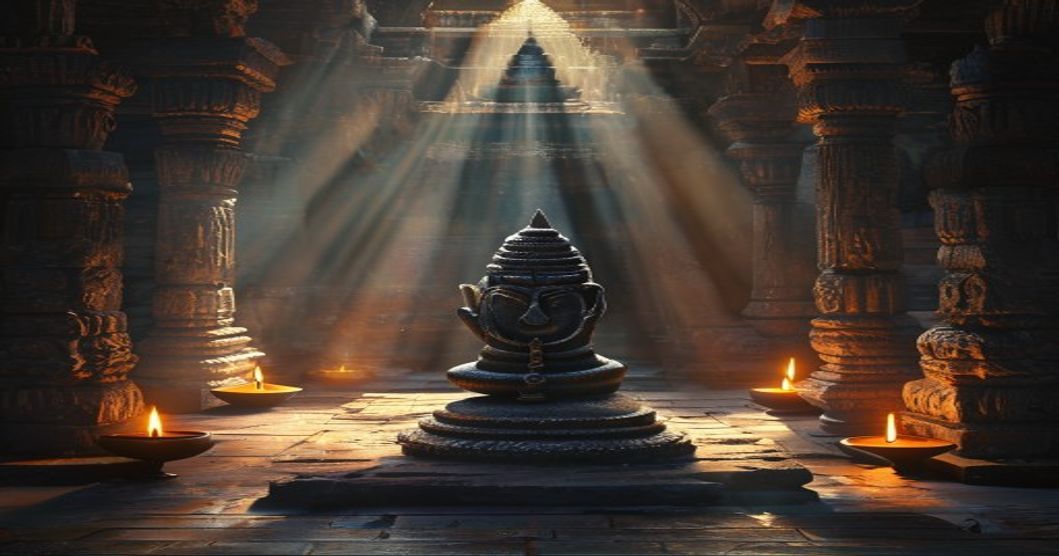
Deep within the heart of Telangana lies an architectural wonder that continues to baffle modern scientists, engineers, and spiritual seekers alike. Built over 1,000 years ago during the reign of the Kunduru Cholas, the Chhaya Someswara Temple (also known as Chaya Someswara Swamy Alayam) in Panagal, Nalgonda, stands as a breathtaking testament to ancient India’s mastery over physics, geometry, and spiritual architecture.
The crown jewel of this sacred shrine is its central deity—a magnificent Shiva Lingam that is perpetually shrouded in a mysterious, unbroken shadow (Chhaya). For centuries, devotees have believed this shadow represents the mystical presence of cosmic entities like Rahu, Ketu, the Sun, and the Moon. But how does a shadow remain completely stationary on the deity from sunrise to sunset, defying the natural movement of the sun? Let us embark on a spiritual and scientific journey to decode this divine enigma.
The Phenomenon of the Eternal Shadow
In most temples, as the sun moves across the sky, shadows cast by pillars shift, elongate, and eventually disappear. However, at the Chhaya Someswara Temple, a dark, distinct shadow of a single pillar rests perfectly upon the Shiva Lingam throughout the day.
While local folklore often associates this phenomenon with astrological mysteries and cosmic forces that shape our destiny—much like the planetary alignments mapped in our natal Birth Chart—modern physicists have a different explanation. They attribute this marvel to the principles of light scattering and wave optics, specifically the double-slit diffraction phenomenon. The temple’s architects positioned the pillars and the inner sanctum in such a precise manner that the light reflecting from multiple pillars creates a unified, stationary shadow on the deity. This proves that ancient Vedic builders understood advanced physics long before these concepts were documented in the West.
Sacred Architecture and the Power of Vastu
The Chhaya Someswara Temple is built in the traditional Trikutalayam style, featuring three shrines (Kutas) dedicated to Lord Shiva, Lord Vishnu, and Lord Surya. The temple’s structural layout is a supreme example of how ancient builders utilized the sacred guidelines of Vastu Shastra to harmonize material structures with cosmic energy.
By aligning the temple’s physical geometry with planetary movements, the creators turned the temple into a living cosmic clock. Walking through its corridors, one cannot help but feel a profound sense of peace and alignment. The pristine stone carvings, depicting scenes from the Ramayana and Mahabharata, serve as visual reminders of our spiritual duties and the laws of cosmic justice.
Spiritual Significance of the Shadow
In Vedic philosophy, light and shadow represent the eternal dance of creation and illusion (Maya). The shadow on the Shiva Lingam is not merely an optical trick; it holds deep metaphysical meaning:
- The Illusion of the Material World: Just as the shadow appears solid but has no physical substance, the material world is an illusion. Lord Shiva, represented by the Lingam, remains unaffected by this illusion, standing as the ultimate reality.
- Cosmic Balance: The union of light (Surya) and shadow (Chhaya) symbolizes the balance of dualities in the universe—good and evil, hot and cold, spirit and matter.
- Cleansing of Karma: Devotees believe that meditating upon this eternal shadow helps dissolve negative impressions and aligns one’s personal Karma with divine will.
Key Highlights for Pilgrims and Seekers
If you are planning a spiritual pilgrimage to this ancient marvel, here are a few essential things to keep in mind:
- Location: The temple is located in Panagal, Nalgonda district, Telangana, approximately 100 km from Hyderabad.
- Best Time to Visit: Maha Shivaratri and Karthika Masam are celebrated here with immense grandeur, attracting thousands of devotees.
- The Three Sanctums: Do not miss the opportunity to offer prayers at all three shrines within the complex to receive the combined blessings of the Holy Trinity (Hari, Hara, and Surya).
A Timeless Monument of Vedic Wisdom
The Chhaya Someswara Temple is a brilliant reminder that spirituality and science are not opposing forces, but two sides of the same coin. The ancient rishis and sthapatis (architects) possessed a deep understanding of the cosmos, which they carved into stone for future generations to marvel at.
To deepen your understanding of ancient Indian temples, Vedic rituals, and spiritual growth, continue your journey of exploration with us at HinduDevGyan—your trusted guide to the eternal wisdom of Sanatan Dharma.