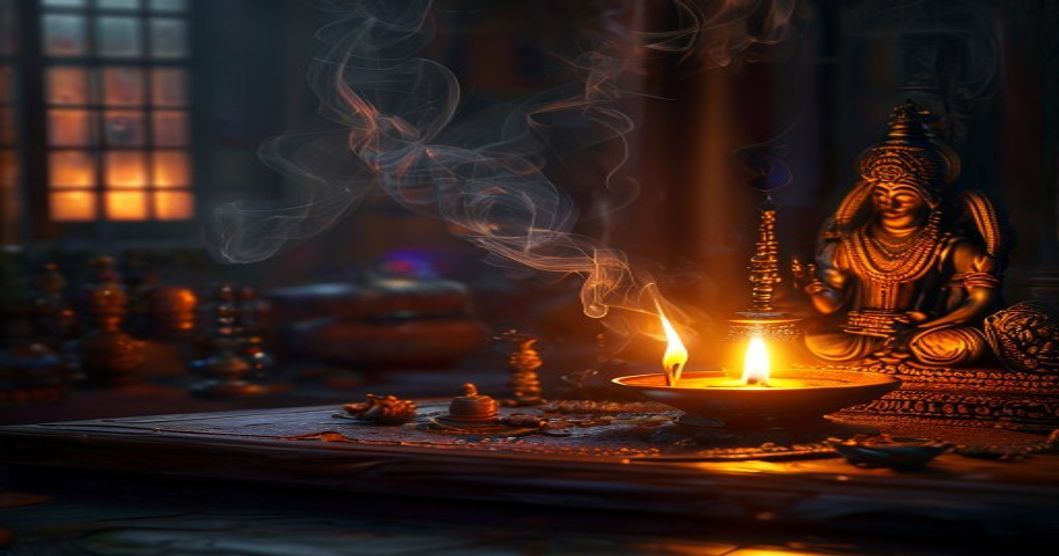
In the rich tapestry of Sanatan Dharma, daily rituals and prayers (Puja) form the cornerstone of spiritual growth. While we are taught from childhood to light a diya in the morning and evening, a common dilemma often arises in our fast-paced modern lives: Can we perform puja at night? If work or travel keeps us busy during the day, does the divine accept our nighttime prayers, or do the scriptures forbid it?
As per ancient Vedic wisdom and the Shastras (sacred scriptures), time is not just a linear concept but a manifestation of cosmic energy. To understand whether nighttime worship is permissible, we must delve deep into the spiritual science of time, energy, and devotion. To deepen your understanding of daily rituals, planetary influences, and scriptural guidelines, you can explore the extensive resources on Hindu Dev Gyan, where ancient wisdom meets modern lifestyle.
The Science of Time: Understanding Vedic Muhurtas
According to Hindu scriptures, the 24-hour day is divided into specific periods, each dominated by a different quality of nature (Guna)—Sattva (purity), Rajas (activity), and Tamas (darkness/inertia).
The ideal time for household worship is during Brahmamuhurta (approximately 1.5 hours before sunrise) and Pratahkal (morning). During these hours, the atmosphere is saturated with Sattva Guna, making it highly conducive to meditation and prayer. The transition period between day and night, known as Sandhyakal (twilight), is also highly sacred for lighting the evening lamp and chanting prayers.
However, as night falls, the environment transitions into Tamas Guna. This shift in cosmic energy is why the Shastras prescribe different rules for nighttime worship.
Can We Pray at Night? What the Shastras Say
The short answer is yes, but with strict conditions and distinct rules. The scriptures do not outright forbid remembering God at night. In fact, mental worship (Manasa Puja) and the chanting of names (Nama Japa) can be done at any time, anywhere, without any restrictions.
However, formal ritualistic worship (Sakaar Puja) involving deities, idols, and elaborate offerings at a home altar during the late-night hours is generally discouraged for householders. The primary reasons are spiritual and metaphysical:
- The Deities’ Sleep (Shayan): According to scriptures, after the evening Aarti, deities enter a state of rest or sleep (Shayan). Worshipping them late at night by offering physical items or chanting loudly is believed to disturb their rest.
- Energy Shift: Late nights are dominated by negative or chaotic energies (Asurika energies) in the outer atmosphere. Without proper protection and initiation, invoking certain energies at night can backfire on a householder.
- The Concept of Nishita Kaal: The midnight hour, known as Nishita Kaal, is highly powerful but is reserved primarily for ascetics, Tantric practitioners, and specific festivals.
Strict Rules to Follow for Nighttime Puja
If your schedule dictates that you must perform your daily prayers at night, or if you are observing a special vigil, the Shastras mandate that you follow these essential guidelines:
1. Avoid Plucking Flowers and Tulsi Leaves: Never pluck flowers or Tulsi leaves after sunset. It is considered a grave sin in Hindu scriptures, as plants are believed to be asleep.
2. Do Not Ring Bells or Blow the Conch: Avoid ringing loud prayer bells (Ghanti) or blowing the conch (Shankha) during late-night prayers. This is to ensure you do not disturb the resting deities or the peace of your surroundings.
3. Keep the Puja Simple: Instead of elaborate rituals, focus on silent meditation, reading sacred texts like the Bhagavad Gita, or chanting mantras silently.
4. Close the Temple Curtains (Pata): In most traditional households, a curtain is drawn over the home temple after the evening Aarti (around 8:00 PM or 9:00 PM) to signify that the deities are resting. Once the curtain is drawn, physical worship should not be performed.
Exceptions: When Night Worship Becomes Highly Auspicious
While daily routine worship is restricted at night, there are grand exceptions where nighttime worship is not only allowed but is considered exceptionally rewarding. Certain deities and festivals are intimately connected with the night:
During Maha Shivratri, the entire night is divided into four quarters (Prahars), and worshipping Lord Shiva during these hours destroys lifetimes of negative karma. Similarly, during Janmashtami, Lord Krishna’s birth is celebrated at the stroke of midnight. The night of Diwali is dedicated to welcoming Goddess Lakshmi through midnight prayers, and Navratri nights are highly potent for worshipping Goddess Durga in her various manifestations, particularly Goddess Kali.
Ultimately, while rules and rituals help channel cosmic energies correctly, the scriptures emphasize that pure love and devotion (Bhakti) transcend all rules of time and space. If your heart is pure, even a silent prayer whispered in the dark of night reaches the Divine.