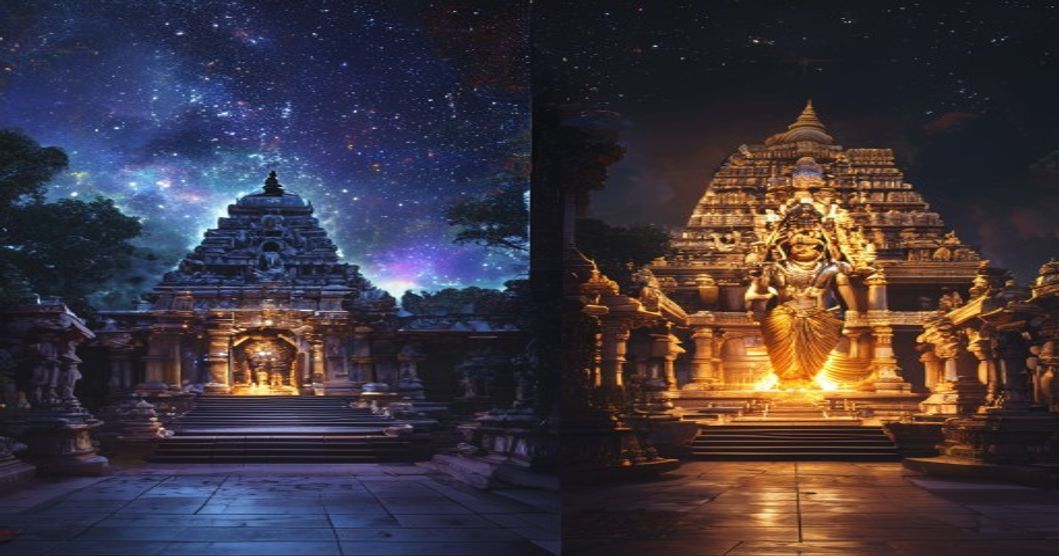
Step into any ancient Shiva temple, and as you circumambulate the sanctum, your eyes will inevitably fall upon a small, elevated square platform housing nine distinct stone deities. These are the Navagrahas—the nine planetary lords of Vedic astrology. Yet, if you walk into a majestic Vaishnava temple dedicated to Lord Vishnu, Lord Krishna, or Lord Rama, this planetary shrine is conspicuously absent.
For centuries, devotees and seekers have pondered this architectural and theological divergence. Why do the planetary rulers of human destiny reside in the abode of the Destroyer, yet find no designated place in the temples of the Preserver? As we explore the depth of Vedic traditions on Hindu Dev Gyan, we uncover the profound metaphysical, astrological, and scriptural secrets that explain this fascinating temple mystery.
Lord Shiva as Mahakal: The Supreme Master of Time and Karma
To understand why the Navagrahas are integral to Shaivite worship, one must look at the cosmic role of Lord Shiva. In the Vedic pantheon, Shiva is worshipped as Mahakal—the Lord of Time, Death, and Transcendence. The nine planets (Surya, Chandra, Mangal, Budha, Guru, Shukra, Shani, Rahu, and Ketu) are the celestial agents tasked with executing the laws of karma across the timeline of human existence.
Because the Navagrahas operate under the direct command of Mahakal, they are positioned within His temple complex. When devotees suffer from severe planetary afflictions or Graha Doshas (such as Shani’s Sade Sati or Rahu-Ketu obstacles), they pray to Lord Shiva. By worshipping the master, the planetary servants are naturally appeased. Shiva is also the only deity who can alter the script of destiny written by the planets, making the presence of the Navagrahas in His courtyard spiritually essential.
The Vaishnava Perspective: Why Lord Vishnu Transcends Astrology
In contrast, the theological framework of Vaishnavism presents a different path to spiritual liberation. According to sacred texts like the Srimad Bhagavatam and the Bhagavad Gita, Lord Vishnu is Purushottama—the Supreme Cosmic Personality who exists entirely beyond the material modes of nature (Sattva, Rajas, and Tamas) and the influence of time.
In Vaishnava philosophy, particularly the doctrine of Sharanagati (absolute surrender), a devotee who surrenders completely to Lord Vishnu is immediately liberated from the bondage of material karma. Because the Navagrahas only govern material karma, they have no jurisdiction over a pure devotee of Vishnu. Therefore, installing a Navagraha shrine in a Vaishnava temple is considered redundant. A famous Sanskrit maxim summarizes this beautifully: “Vāsudevaḥ Sarvam Iti”—worshipping Vishnu is equivalent to watering the roots of a tree; once the root is watered, all the branches (the demigods and planets) are automatically nourished.
Key Differences: A Scriptural Comparison
The distinction between Shaivite and Vaishnavite temple layouts is not a matter of sectarian rivalry, but rather a reflection of different paths of spiritual science. Here is a breakdown of how both traditions view the planetary forces:
- The Concept of Cosmic Governance: In Shaivism, the Navagrahas act as administrative officers of karma under Shiva’s cosmic court. In Vaishnavism, the planets are viewed as mere limbs of the Vishwaroopam (the supreme cosmic form of Lord Vishnu), rendering individual worship of the limbs unnecessary when the whole body is worshipped.
- The Role of Sri Hanuman and Garuda: In many Vaishnava temples, deities like Hanuman or Garuda are positioned to protect devotees from negative planetary energies. For instance, Lord Shani (Saturn) promised Hanuman that he would never trouble Hanuman’s devotees, eliminating the need for a separate Shani or Navagraha shrine.
- Sadhana and Focus: Shaivite worship often deals with the purification of worldly karmas and the pacification of planetary energies. Vaishnavite worship focuses primarily on Bhakti (pure devotion) and attaining Moksha (salvation) in Vaikuntha, a realm far beyond the reach of astrological planets.
The Harmonious Unity of Vedic Wisdom
Ultimately, both temple structures reflect the infinite depth of Hindu spiritual science. While Shaivite temples provide a practical, systematic pathway to harmonize our earthly life by acknowledging the power of the Navagrahas under the shelter of Lord Shiva, Vaishnavite temples offer a path of transcendental surrender, where the devotee rises above the stars themselves through absolute faith in Lord Vishnu. Both approaches lead to the same ultimate truth: the material universe, with all its planets and stars, is merely a play of the one Divine Consciousness.