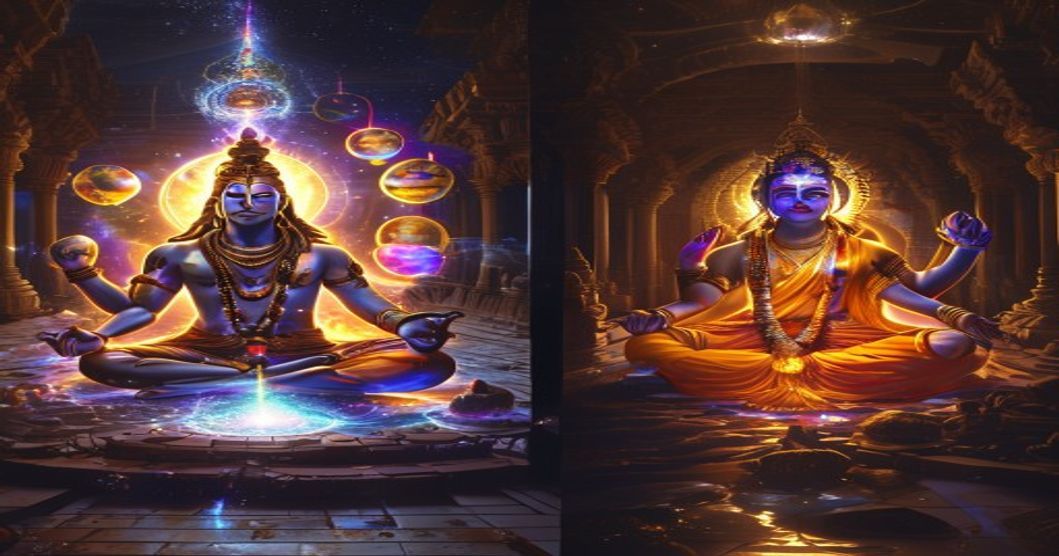
If you have ever visited a traditional Hindu temple, you may have noticed a fascinating architectural contrast. In almost every temple dedicated to Lord Shiva, there is a dedicated shrine in the northeast corner housing the Navagrahas—the nine celestial deities representing the planets that govern human destiny. However, when you step into a Vaishnava temple (dedicated to Lord Vishnu or His avatars like Rama and Krishna), these nine planetary deities are conspicuously absent.
Why this stark difference? Is it a matter of sectarian preference, or does it hold a deeper, profound scriptural and astrological secret? As we delve into the sacred texts of the Puranas, the Agamas, and Vedic astrology, we uncover a beautiful synthesis of cosmology, theology, and the ultimate path to spiritual liberation.
Lord Shiva as Mahakala: The Lord of Time and Cosmic Order
In Hindu cosmology, Lord Shiva is revered as Mahakala—the ultimate master of Time, Space, and Dissolution. The nine planets (Surya, Chandra, Mangala, Budha, Guru, Shukra, Shani, Rahu, and Ketu) are cosmic administrators. They execute the laws of karma, delivering fruits of past actions to living beings.
According to Saivite scriptures, the Navagrahas derive their administrative authority directly from Lord Shiva. In fact, many Puranic legends dictate how different planets performed intense penance (Tapasya) to please Lord Shiva to earn their planetary status. For instance, Lord Shani (Saturn) obtained his position as the judge of karmic deeds through Shiva’s blessings.
Because Lord Shiva is the supreme controller of these celestial bodies, placing the Navagrahas inside His temple courtyard signifies their subordination to the supreme cosmic order. When devotees worship Lord Shiva, they naturally appease the planetary deities. For those seeking to mitigate the malefic planetary alignments in their birth chart or Horoscope, worshipping Shiva alongside the Navagrahas is considered the ultimate remedy.
Saranagati: Why Vaishnava Temples Transcend Planetary Worship
To understand why Vaishnava temples do not house the Navagrahas, we must look at the core philosophy of Vaishnavism, particularly the concept of Saranagati (absolute surrender to the Supreme Lord Narayana).
In Vaishnavite theology, Lord Vishnu is the Supreme Personality of Godhead, the preservation force of the entire cosmos. According to the Pancaratra Agamas (the scriptures governing Vaishnava temple rituals), a soul that surrenders completely to Lord Vishnu is immediately liberated from the bondage of material karma.
Since the Navagrahas only govern material karma and destiny, they have no jurisdiction over a surrendered devotee of Vishnu. As Lord Krishna declares in the sacred Bhagavad Gita, those who take shelter in Him transcend the material modes of nature. Therefore, a Vaishnava devotee does not feel the need to worship the planets separately, as loving devotional service to Vishnu automatically pleases all cosmic administrators.
The Protective Shield of Sudarshana and the Pancharatra Agama
Instead of the Navagrahas, Vaishnava temples feature distinct protector deities who govern cosmic order and shield devotees from planetary afflictions:
- Sudarshana Chakra: The divine discus of Lord Vishnu represents the cosmic mind and ultimate protection. It is believed that the Sudarshana Chakra controls the movement of all planetary bodies and nullifies any negative astrological influences.
- Garuda: The divine mount of Vishnu, representing the Vedas, stands facing the main deity, offering protection from all toxic and malefic energies.
- Vishvaksena: The commander-in-chief of Vishnu’s army, who removes obstacles and manages the administrative affairs of the universe.
Thus, in a Vaishnava temple, the Sudarshana Chakra acts as the ultimate shield against any adverse planetary transits. When planning auspicious events, rather than worrying about planetary afflictions, Vaishnavas consult the sacred Panchang to find a holy time (Muhurat) dedicated to the service of the Lord, relying entirely on His divine grace.
Key Structural and Philosophical Differences at a Glance
To summarize this profound temple mystery, let us look at the key differences in how these two major traditions approach cosmic energies:
- Cosmic Governance: In Shiva temples, the Navagrahas are worshiped to harmonize material energies and seek relief from karmic debts. In Vishnu temples, devotees focus solely on spiritual liberation (Moksha) through devotion.
- Placement of Deities: In Shiva temples, Navagrahas are placed in a specific 3×3 grid facing different directions to maintain cosmic equilibrium. In Vaishnava temples, the Sudarshana Chakra or the deity of Lord Dhanvantari is installed to bestow health and protection.
- Path of Remedies: Shiva temples emphasize systematic rituals to pacify individual planets based on one’s destiny. Vaishnava temples emphasize chanting the Holy Names of Vishnu, which is believed to easily burn away lifetimes of karmic reactions.
Conclusion: Two Paths to the Same Divine Reality
Ultimately, the presence of Navagrahas in Shiva temples and their absence in Vaishnava temples is not a contradiction, but a beautiful representation of the diverse paths within Hindu dharma. Shiva temples offer a structured, cosmic approach to navigating the laws of karma and time. Vaishnava temples offer a path of absolute surrender, inviting the devotee to step beyond the influence of the planets into the direct, protective grace of the Supreme Preserver.
Both architectural designs are scientifically and spiritually structured to elevate the human consciousness. For more profound insights into Vedic wisdom, temple secrets, and spiritual practices, continue your journey of discovery at HinduDevGyan.